Sachin Tendulkar’s century at Perth in 1992, made as an eighteen-year-old on the fastest, bounciest pitch in world cricket, is remembered above all for one shot: the back-foot punch through cover and point, played with a still head against bowlers pushing the ball through at his ribs. Coaches have used that innings as a reference point ever since, because the back-foot punch is the clearest single indicator of a technically complete batter. It requires no slog, no risk and no premeditation — just balance, depth in the crease and the confidence to score off good bowling rather than merely survive it.
What Separates a Punch From a Cut
The two shots answer different deliveries. The square cut attacks width: a ball short and well outside off stump, hit with a horizontal bat, square or behind square. The back-foot punch answers a far more awkward ball — short of a good length, close to off stump, too tight to cut square with a horizontal blade and too short to drive off the front foot. Most batters defend it. The punch turns it into runs.
Technically, the punch is a vertical-bat shot. The full face of the bat meets the ball under the eyes, and the follow-through is compact — a firm extension of the hands through the line rather than a flourish. The ball travels along the ground between cover and mid-off, or straighter past the bowler when the line is tighter. Because the bat stays vertical, the margin for error against extra bounce or late movement is far greater than in any cross-batted alternative. That is why the shot survives on fast pitches where the cut becomes a liability.
The Footwork Sequence, Step by Step
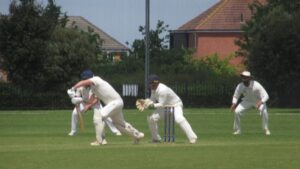
Everything in the punch flows from the first movement: back and across. The back foot presses towards off stump and slightly deeper in the crease, opening enough for the hips to clear while the head stays level and forward of the body’s centre. Batters who fall away to leg, or whose back foot goes straight back rather than across, end up hitting the ball square with a closed face — or missing it altogether.
The three checkpoints
- Depth: the back foot moves deep enough to buy time, converting a ball that would hit the splice into one met at the bat’s sweet spot.
- Height: the batter rises with the bounce, on the balls of the feet, so contact happens under the eyes rather than out in front.
- Hands: the top hand controls the shape; the bottom hand adds a short, late push at contact. Bottom-hand dominance is what sends punches in the air towards cover.
All of it rests on the platform built long before the ball is bowled. A stable base, a grip that lets the full face flow through the line, and a head position over off stump are covered in any serious treatment of batting stance and grip fundamentals, and no shot exposes flaws in that platform faster than the back-foot punch.
When to Play It — and When to Leave It
Length is the trigger. The punch lives in the band between a good length and genuinely short: too full and the batter is reaching, playing away from the body with the weight stranded; too short and the ball is above the hands, where the pull, the sway or the well-judged leave are better answers — decisions that belong to the separate craft of handling the short ball. Line matters equally. The punch works between off stump and a few centimetres outside it. Wider than that, the cut or the leave takes over.
Surface dictates how often the shot appears. On true, bouncy pitches — Perth, Centurion, the best of Australia’s drop-ins — the punch is a primary scoring option because the bounce is predictable and the vertical bat covers it. On slow, low subcontinental surfaces the ball rarely arrives at a punchable height, which is why touring batters raised on low bounce often struggle to score off the back foot in Australia and South Africa: the shot simply is not grooved into their game.
The Modern Masters
Virat Kohli’s back-foot punch through the covers, wrists closing the face a fraction at contact, has been one of the signature shots of the modern era — most memorably against Australian pace on Indian tours there. Kane Williamson plays the softest version of the shot, meeting the ball later than almost anyone and using the pace already on it, so that a defensive-looking push runs away for four. Babar Azam’s punch is the aesthetic middle ground, all balance and full face. What unites them is not power — none of them muscles the ball — but the time they appear to have, which is really depth of crease and stillness of head. The archives at ESPNcricinfo are full of hundreds built substantially from this one unglamorous shot, and a fuller map of where it sits among the game’s strokes runs through any complete guide to batting technique.
Why It Signals a Complete Batter
Bowlers build pressure by bowling the ball batters cannot score off, and the short-of-a-length delivery at off stump is the most reliable dot ball in cricket. A batter who can punch it for runs removes the bowler’s stock plan entirely, forcing a change of length — fuller, into driving range, or shorter, into pulling range. That is the quiet strategic value of the shot: it does not just score, it drags the bowler away from the length they want to live on. For any developing player, the back-foot punch is worth hundreds of hours in the nets, not because it is spectacular, but because owning it means there is no longer a safe place to bowl.
Frequently Asked Questions
How does the back-foot punch differ from a cut?
The back-foot punch is a vertical‑bat shot played from a deep back‑foot stance against a short, off‑stump delivery, whereas the square cut uses a horizontal bat to attack a short, wide ball outside off stump.
What key elements ensure a successful back-foot punch?
Balance, a deep crease position, and confidence to meet the ball with the full face of the bat are essential; the batter must maintain stability, keep the head still, and time the vertical bat swing precisely on the awkward short delivery.
Why is the back-foot punch considered a technically complete shot?
Because it requires no premeditated footwork, no slogging, and no risky shot selection; the batter simply uses balance and depth to turn a difficult short ball into runs, demonstrating mastery of timing, bat angle, and body alignment.
Which historic innings popularized the back-foot punch?
Sachin Tendulkar’s 1992 century at Perth, scored at age eighteen on a fast, bouncy pitch, highlighted the back‑foot punch through cover and point, and has since been referenced by coaches as the benchmark for the technique.