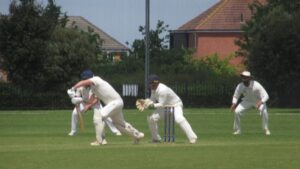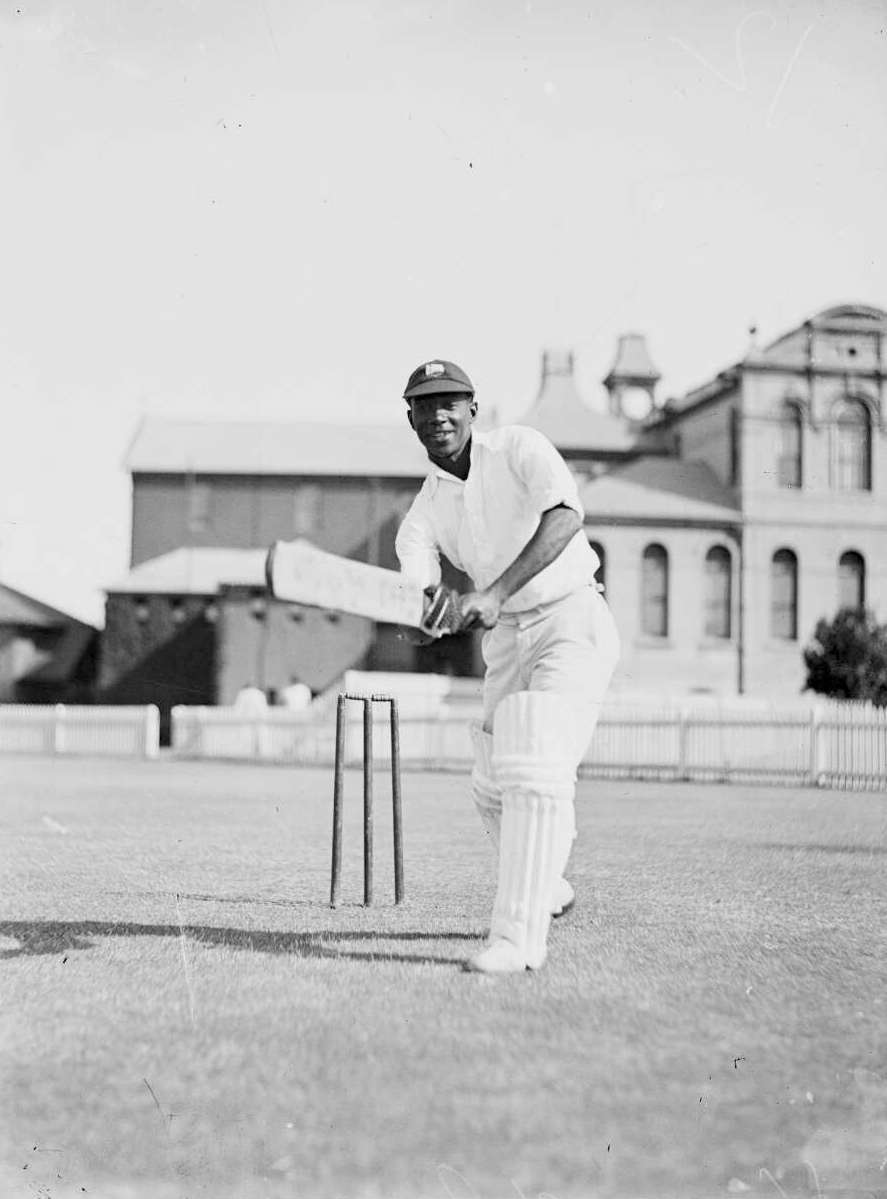
A batter who survives the first over of a Test innings and one who is bowled second ball often differ by no more than a few centimetres of head movement and a fraction of a second in decision-making. Batting rewards small margins. The way the hands sit on the handle, where the eyes are at the moment of contact, and which foot moves first all compound into the difference between a controlled drive and an edge to the keeper. This guide breaks the craft down into its working parts, then links to the deeper explainers in our batting cluster.
Quick answer:
Cricket batting technique involves mastering
The Grip and Stance That Hold Everything Together
Almost every batting fault can be traced back to either the grip or the stance, because both are set before the bowler has even released the ball. The orthodox grip places the hands close together near the top of the handle, with the “V” formed by thumb and forefinger of each hand running roughly down the back of the bat in a continuous line. The top hand does most of the controlling work; the bottom hand is a guide and a source of power, not a steering wheel. When the bottom hand grips too tightly or sits too far round the handle, the bat face tends to close early, dragging shots to the leg side and producing leading edges against anything that moves away.
The stance organises the body so that it can move efficiently in any direction. Feet are about shoulder-width apart, weight balanced on the balls of the feet rather than the heels, knees slightly flexed, and the head still and level. A side-on or slightly open stance lets the batter watch the bowler with both eyes while keeping the front shoulder pointing down the pitch. The bat is usually tapped gently in the ready position — a small trigger of rhythm that prevents the body from freezing. None of this is decoration: a balanced, repeatable starting position is what allows the trigger movement and the shot to follow without conscious thought. Our dedicated breakdown of the batting stance and grip fundamentals works through the common variations and how to correct them.
Why Head Position and Balance Decide the Shot
If a coach could fix only one thing in a struggling batter, most would choose the head. The head is the heaviest concentrated weight in the upper body, and where it goes, balance follows. The guiding principle is simple to state and hard to master: the head should move towards the line of the ball and stay still at the moment of contact, ideally positioned over or just inside the front knee for front-foot shots. When the head falls away to the off side, the weight tips with it, the front shoulder lifts, and the bat arrives across the line rather than down it.

Balance is the partner of head position. A batter who is balanced can transfer weight smoothly from back foot to front foot and abort a shot late if the ball deviates. A batter who is off balance is committed before the ball has finished its journey, which is fatal against swing and spin. Good players give the impression of having more time precisely because their balance lets them watch the ball longer and decide later. Stillness of the head at release, then a single decisive movement towards the pitch of the ball, buys those extra milliseconds. Everything that follows in this guide depends on this foundation being in place first.
Front-Foot Drives: The Foundation of Run-Scoring
The drives are the most aesthetically prized shots in the game and the most technically demanding, because they are played to fuller deliveries where the margin for error in timing is small. The family includes the cover drive, the straight drive, the on drive and the square drive, distinguished mainly by the line of the ball and the direction in which the front foot and bat send it.
The mechanics are broadly shared. The front foot strides towards the pitch of the ball — not across it and not down the pitch blindly — bending at the knee so the head finishes over the ball. The bat swings as a pendulum from a high backlift down through the line, with the top hand leading and the face presented to the intended direction. Contact is made under the eyes, close to the front pad, with the full face of the bat. The follow-through finishes high and in the direction of the shot. Crucially, the front elbow stays reasonably high through the straight and cover drives, keeping the bat swinging down the line rather than across it; a dropping elbow is what turns an intended cover drive into a thick edge.
The cover drive in particular rewards patience, because it is played to a ball pitched on or just outside off stump — exactly the channel bowlers target to induce the edge. The safe version is played late, under the eyes, with the weight forward. The dangerous version is the reach, where the foot fails to get to the pitch and the hands push at the ball away from the body. Our guide to the cover drive technique covers how to judge when the shot is on and how to keep the head from toppling to the off side. The on drive, played to a ball on middle-and-leg, is considered the hardest of all because the front leg can get in the way of the swing; it demands an especially precise stride that points the toe down the pitch and a top hand that works the bat past the front pad.


Back-Foot Play: Cut, Pull and Hook
When the ball is short, the front foot is the wrong tool. Back-foot shots give the batter time and leverage against rising deliveries, and they are how good players punish anything dropped short. The first movement is back and across — the back foot moves towards the off stump and deeper in the crease, creating room and getting the body in line or out of the line as the shot requires.
The cut is played to a short, wide delivery outside off stump. The batter waits for the ball to rise to a comfortable height, rocks onto the back foot, and slashes down on it with the bat coming from high to low, rolling the wrists at contact to keep the ball along the ground through the off side. Playing the cut too early, before the ball has passed the body, is a common cause of edges to the slips or keeper.
The pull and the hook are leg-side shots to short balls aimed at the body or the leg side. For the pull, the batter gets back and across, swivels on the back foot, and swings the bat in a horizontal arc to send a ball of roughly chest height through the leg side, keeping it down by hitting over the top of it. The hook is the higher-risk cousin, played to a ball climbing towards the head or shoulder, often hit in the air. Both demand quick judgement of length and the discipline to roll the wrists and keep the ball down, or to sway out of the way entirely when the shot is not on. The decision to pull or to duck is one of the fastest a batter ever makes. Our explainer on the pull and hook shots details how to read length early and when to leave the shot alone. Knowing where the catchers are stationed shapes the choice too — a fine leg and a deep square leg in place are a clear signal that the bowler is inviting the hook, and a glance at our guide to fielding positions in cricket shows how those traps are set.
Playing Spin: Footwork as the First Line of Defence
Spin bowling turns batting into a problem of footwork and judgement rather than reflex. Against pace the ball arrives quickly but on a predictable line; against spin the ball is slower but deviates off the pitch, dips in flight, and is bowled to tempt the batter into errors of length. The batter’s footwork is what neutralises the turn.
Two movements matter most. Coming forward to the pitch of the ball smothers the spin: if the foot gets close enough to the bounce, the ball has no distance in which to deviate, and the batter can drive or defend with the spin. Going back deep in the crease against a shorter ball gives time to watch the turn and play it late, off the back foot, with soft hands. The cardinal error is to be caught on the crease — neither forward nor back — because that is precisely the length at which the ball has room to turn and beat the bat. Reading the spinner’s hand and the flight, playing the ball under the eyes, and using the crease depth fully are the core skills, all of which our primer on playing spin bowling footwork sets out in detail.
Two further principles help. First, play the ball as late as possible, letting it come to you rather than chasing it, so that any deviation has already happened by the time the bat arrives. Second, use the depth and width of the crease — a half-step back can convert a good-length ball into a short one, and a step down the pitch can convert it into a half-volley. Against the turning ball, the batter who only ever stands still is at the mercy of the bowler; the one who moves decisively, forward or back, dictates terms.
Defensive Technique: Survival Before Strokeplay
Attractive strokeplay is built on a reliable defence, because a batter who cannot protect the stumps and play out good deliveries never lasts long enough to score. The two defensive strokes are the forward defensive and the backward defensive, and both share the same priorities: get the body in line, keep the bat close to the front pad, present a straight full face, and play with soft hands so the ball drops at the feet rather than carrying to a fielder.
The forward defensive is played to a good-length ball on or around the stumps. The front foot moves to the pitch, the head goes over the ball, and the bat comes down straight with the top hand controlling and the bottom hand barely gripping, angling the face down so the ball is killed dead. The backward defensive answers a slightly shorter ball: the batter goes back and across, plays the ball under the eyes with the bat vertical, and lets the pace go out of the shot. The hallmark of good defence is that the ball does not travel — soft hands and a relaxed bottom-hand grip absorb the impact. A rigid bottom hand pops the ball up into the cordon; a loose, giving grip drops it harmlessly. The defensive game also teaches the most valuable batting discipline of all: the leave. Knowing which deliveries to ignore — anything wide of off stump that does not threaten the wicket — preserves the innings and forces the bowler to bowl straighter, where runs are easier to come by.
Shot Selection and Reading the Game
Technique answers the question “how do I play this shot?” Game awareness answers the far more important question “should I play it at all?” The best batters are ruthless editors of their own options. Each delivery presents a choice based on its length and line, the field that is set, the state of the match, the condition of the pitch, and the batter’s own form and footwork on the day.

Length is the primary cue. Full balls invite drives; short balls invite cuts, pulls and hooks; good-length balls are usually defended or worked into gaps. Line dictates the side of the wicket. The field then refines the decision: a packed off-side ring means the gaps are square or behind on the leg side, and reading where the fielders stand turns a defensive over into one that yields singles. A working knowledge of where fielders are placed and why lets a batter target the gaps rather than the men, which is the essence of rotating strike.
Match situation reshapes everything. A batter rebuilding after early wickets plays straighter, leaves more, and accepts dot balls; one chasing a steep target in a limited-overs run-out manufactures boundaries and takes calculated risks. Nowhere is this clearer than at the death of a T20 innings, where bowlers deploy yorkers, slower balls and wide lines specifically to deny the big shot. Understanding the bowler’s plans — laid out in our look at death bowling tactics in T20 cricket — lets a batter pre-empt them, by premeditating the scoop to a yorker or making room to a wide line. And in the highest-pressure format of all, the tie-breaking Super Over, shot selection compresses to its purest form: with only six deliveries and no margin for a rebuild, every ball must be a clear, committed decision. Pressure does not change technique, but it punishes indecision more severely than any bowler can.
Practice, Drills and Building a Repeatable Game
Technique is grooved through repetition under conditions that gradually approach the real thing. The progression most coaches favour moves from the simplest, most controllable feed to the most chaotic and match-like.
- Shadow batting with no ball at all engraves the movement pattern — trigger, stride, swing, follow-through — until it becomes automatic and the batter can feel a fault before a ball exposes it.
- Drop-feed and throwdowns let a coach place the ball precisely on a length, so a batter can rehearse a single shot dozens of times and isolate one fault, such as a falling head on the cover drive.
- Bowling-machine work grooves timing against a consistent pace and length, and is ideal for back-foot drills where the same short ball can be repeated until the swivel and the wrist-roll are reliable.
- Net practice against live bowling reintroduces variation, deception and the need to read the bowler, which a machine cannot replicate, and is where shot selection and footwork against spin are genuinely tested.
Two habits separate productive practice from going through the motions. The first is intent: every ball in the net should be treated as a decision, with the batter leaving the ones that should be left rather than waving at everything. The second is feedback — filming the stance and the drives, or having a coach watch the head position, turns vague effort into specific correction. A batter who practises with the same discipline they want in a match builds a game that holds up when the pressure arrives. The formal framework that governs everything from the crease markings to legal deliveries is worth knowing too; the MCC’s Laws of Cricket define the boundaries within which all of this technique operates.
What to Read Next
This guide is the hub for our batting cluster; each linked explainer goes deeper into one piece of the craft. Begin with the stance and grip fundamentals, since every other skill is built on that foundation, then work through the cover drive for front-foot timing and the pull and hook shots for handling pace and bounce. Tackle the turning ball with our footwork basics for playing spin. To sharpen the decision-making side of batting, read how to exploit gaps using cricket’s fielding positions and how batters counter death bowling in T20s. Work through them in order and the abstract idea of “good technique” becomes a set of concrete, practisable habits.
Related: 9 Essential Elements of the Perfect Batting Stance and Grip Every Cricketer Should Know
Frequently Asked Questions
How does grip affect batting power?
An orthodox grip aligns the thumbs and forefingers in a V‑shape along the bat's back, allowing the top hand to control the blade while the bottom hand adds leverage. This positioning maximises energy transfer and generates consistent power through the shot.
What foot should move first in a drive?
In a classic drive, the front foot initiates movement, stepping towards the ball's line to provide a stable base. This early footwork anchors the body, enabling the hips to rotate and the bat to meet the ball at the optimal contact point.
Why is head stillness important when batting?
Maintaining a still head ensures the eyes stay fixed on the ball's trajectory, reducing parallax error at the moment of contact. Minimal head movement improves timing precision, allowing the bat to strike the middle of the ball for optimal control.
How does stance width influence shot selection?
A slightly wider stance provides a broader balance platform, facilitating weight transfer to both front and back foot. This flexibility allows the batter to execute a range of shots, from defensive pushes to aggressive drives, without compromising stability.