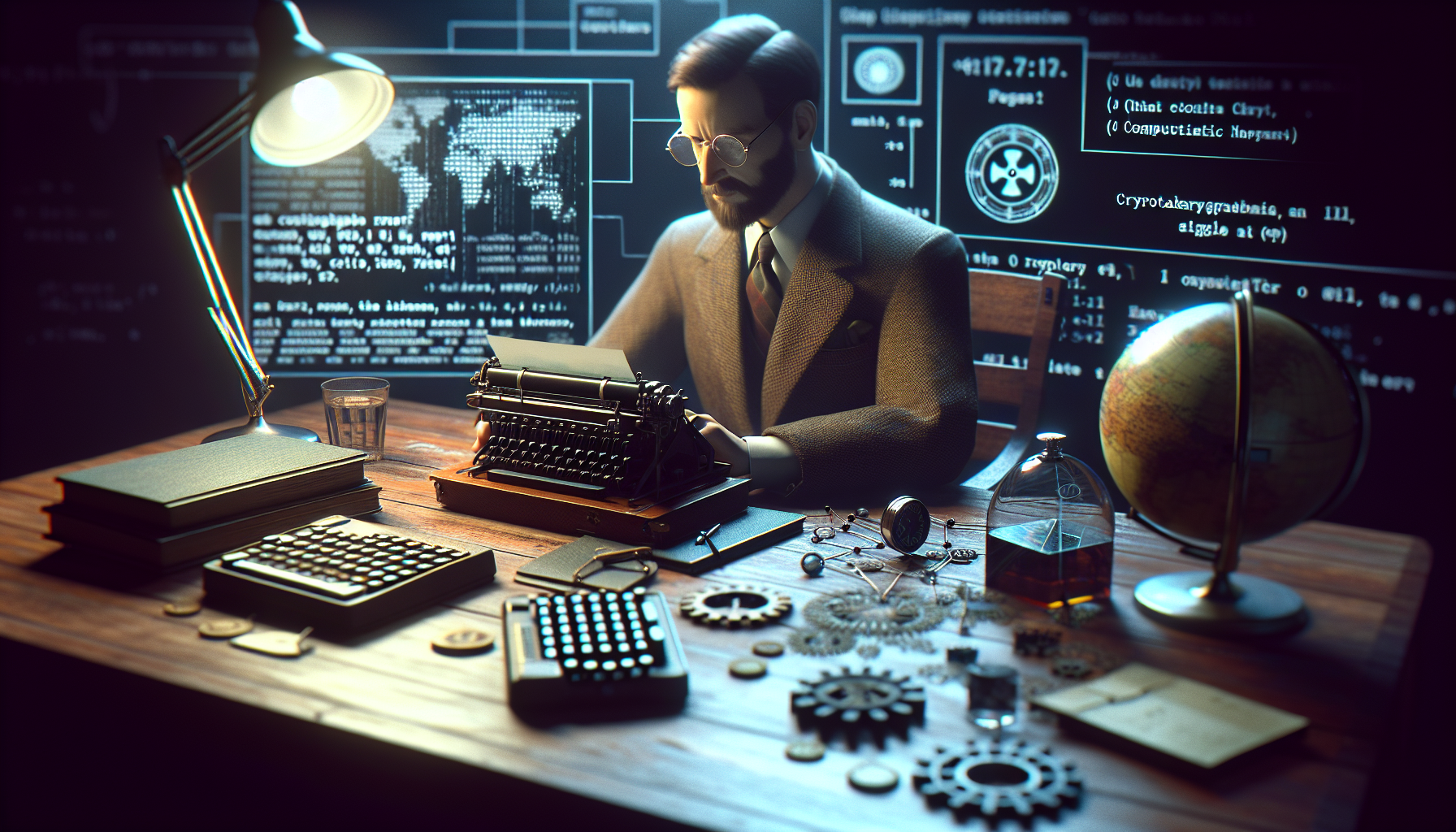
Deciphering War: Turing’s Ingenious Triumph
Alan Turing is often celebrated as a pioneer in the world of computer science and artificial intelligence, but his role in World War II as a code-breaker is a story of brilliance that resonates to this day. Amid the chaos of global conflict, Turing’s work at Bletchley Park, Britain’s top-secret code-breaking center, became a linchpin in the Allied forces’ strategic toolkit. With the help of a dedicated team, Turing succeeded in decrypting the German Enigma code—a pivotal moment that arguably shortened the war by several years and saved countless lives.
Bletchley Park: The Cradle of Code-breaking
Situated in the quiet countryside of Buckinghamshire, Bletchley Park was transformed during the war into a hive of intellect and innovation. It was here that Turing, alongside his colleagues, faced the daunting task of decoding the Enigma machine—a seemingly impenetrable encryption device used by the Nazis to securely transmit military communications. The machine’s complexity came from its myriad rotors and wiring settings, which churned out a daily changing cipher, creating a cryptographic puzzle with over 150 quintillion combinations.
In the face of such a mammoth challenge, Turing’s visionary approach led to the creation of the Bombe, an electromechanical device that systematically tested all potential Enigma settings. The eventual success of this endeavor meant not just the deciphering of encoded messages but an unprecedented advantage in anticipating enemy strategies and movements.
The Mind Behind the Machine
Turing’s contributions to cryptanalysis were not just technological; they were deeply rooted in his understanding of mathematical logic. His theoretical work, which laid the groundwork for modern computing, was instrumental in shaping the analytical methods used to tackle the Enigma cipher. Turing’s application of algorithms and logic, concepts that underpin computer science today, transformed the way intelligence was gathered during the war.
While Turing’s work with the Bombe often takes center stage, his broad foresight extended beyond the immediate demands of warfare. He envisaged machines that could reason and learn beyond their programmed instructions—a revolutionary idea that sowed seeds for the field of artificial intelligence. Turing’s paper, “Computing Machinery and Intelligence,” published in 1950, explored the concept of machine learning, a field that has seen exponential growth in modern times.
The Human Element: Collaboration at the Heart of Success
Though Turing’s intellect was astonishingly singular, the success at Bletchley Park was a testament to collaborative effort. The code-breaking operation drew from a diverse pool of talent, including mathematicians, linguists, chess champions, and even crossword puzzle experts. This eclectic mix of expertise enriched the innovative atmosphere, enabling breakthroughs that might have been impossible in a less diverse environment.
Women played a crucial and often overlooked role in these endeavors. Many of the code-breakers, known as “Wrens,” were involved in operating the Bombe machines and analyzing intercepted messages. Their contribution was vital, bringing diverse perspectives and sharpening the team’s effectiveness.
Legacy and Recognition
Despite the monumental impact of Turing’s wartime achievements, recognition was slow in coming. The official secrets surrounding Bletchley Park’s operations were not lifted until decades later, which meant that Turing’s pioneering work remained shrouded in obscurity. It wasn’t until the 21st century that Turing began to receive widespread acknowledgment, celebrated for his extraordinary contributions and awarded a posthumous pardon from the British government for his conviction for homosexuality, which had led to personal and professional tragedy.
In recent years, cultural mediums have taken Turing’s story to a broader audience. Films, documentaries, and books have all explored his complex legacy, with the movie “The Imitation Game” notably bringing his story and struggles to a global stage. According to BBC iPlayer, such narratives have played a critical role in publicizing Turing’s contributions, helping ensure that his genius—and the lessons from his life—remain relevant.
Impact on Modern Technology
The implications of Turing’s work during the war extend far beyond the battlefields of the 1940s. Today, Turing’s ideas underpin numerous aspects of modern technology. The logical processes that he developed resonate within computational systems that drive sectors from healthcare to finance. In an era where cyber threats persist, lessons from Turing’s time in code-breaking continue to inform cybersecurity advancements.
Machine learning and artificial intelligence technologies owe a debt to Turing’s early vision of machines capable of learning. Smart assistants, recommendation systems, and automated processes that we often take for granted today can trace their ancestry back to the theoretical foundations laid by Turing.
Frequently Asked Questions
Who was Alan Turing?
Turing was a British mathematician and logician who played a pivotal role in breaking the Enigma code during WWII, significantly contributing to the Allied victory. He is also a foundational figure in computer science and artificial intelligence.
What was the Enigma machine?
The Enigma machine was an encryption device used by Nazi Germany during World War II to secure military communications, believed at the time to be unbreakable due to its intricate ciphering mechanism.
How did Turing break the Enigma code?
Turing and his team developed the Bombe, a machine that could decode Enigma messages by systematically testing different settings, thus enabling the Allies to intercept and understand enemy plans.
What is Turing’s legacy today?
Turing’s pioneering concepts in computing and artificial intelligence continue to influence these fields today. His work laid the groundwork for modern computing and contributed significantly to advancements in machine learning and cybersecurity.
What challenges did Turing face due to his personal life?
Turing faced severe persecution due to his homosexuality, which was criminalized in Britain at the time. This personal strife overshadowed his professional achievements during his lifetime, though he was posthumously pardoned and recognized for his contributions.
Frequently Asked Questions
How did Turing break the Enigma code?
Turing designed the electromechanical Bombe, which exploited known plaintext and logical deductions to test rotor settings rapidly, dramatically reducing the number of possible Enigma configurations and allowing British cryptanalysts to decipher intercepted German messages.
What was the role of Bletchley Park?
Bletchley Park served as the United Kingdom’s top‑secret intelligence hub where mathematicians, linguists, and engineers, including Turing, collaborated to decode Axis communications, develop cryptographic machines, and supply actionable intelligence to Allied commanders throughout WWII.
How many possible Enigma settings existed?
The Enigma machine’s three‑rotor configuration produced 17,576,000 possible settings per day, and when extended to the four‑rotor Naval version the combinations rose to over 150 quintillion, making manual decryption practically impossible without mechanized assistance.
Why is Turing considered a WWII hero?
Turing’s breakthroughs in cryptanalysis accelerated Allied decryption of German communications, providing crucial strategic intelligence that shortened the war, saved countless lives, and laid foundational concepts for modern computing, cementing his legacy as a pivotal wartime figure.