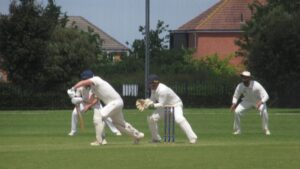
A ball that pitches in the last few inches of the batter’s reach, right under the swinging bat, leaves almost no room to play a controlled stroke. That delivery is the yorker, and it remains one of the hardest balls in cricket to face precisely because it attacks the one spot a batter cannot easily get under or over. Bowled well, it sneaks beneath the downswing and arrows into the base of the stumps or the toes. Bowled poorly, it becomes the easiest ball in the game to hit. The margin between the two is tiny, which is exactly why the skill is so prized.
What a Yorker Is and Why It Works
A yorker is a delivery pitched so full that it lands at or very near the batter’s feet, in the small patch of ground known as the blockhole — the area where the base of the bat meets the popping crease. Because it lands so close to the batter, the ball gives almost no time for it to rise to a hittable height after bouncing. The batter is forced to jam the bat down quickly, often digging it out rather than driving it.
The effectiveness comes down to geometry and timing. Most attacking strokes need the ball to be a certain distance away from the body and at a certain height so the bat can swing through the line. A yorker denies both. It arrives full, low and late, removing the swing arc the batter relies on for power. Even a batter who reads it early can usually only smother it. If they misread it, the ball passes under the bat entirely and hits the stumps or traps the front foot. Within a bowler’s broader skill set — covered in our complete guide to cricket bowling — the yorker is the most direct way to deny a batter time.
The Grip and the Release
A yorker does not need a special grip the way a swinging delivery or an off-cutter does. Most bowlers use their stock grip — typically the seam held upright between the index and middle fingers, with the thumb resting underneath on the seam. What changes is not the grip so much as the length the bowler is aiming for and the point of release.
The key adjustment is releasing the ball slightly later and aiming the trajectory much fuller than a good-length ball. To pitch a ball right at the batter’s feet, the bowler must visualise a target on the ground that is far closer to the stumps than usual — often the base of the stumps themselves rather than a length spot four or five metres in front. A common coaching cue is to aim for the batter’s toes or the bottom of the stumps, because aiming “full” alone tends to produce a half-volley rather than a true yorker.

Other technical points that help:
- A strong, braced front leg at delivery, which lets the bowler pull down hard over the front of the body and drive the ball full and fast.
- A slightly lower or flatter release in some bowlers’ actions, which keeps the trajectory descending sharply into the blockhole rather than looping.
- Pace and intent — a yorker bowled with full effort is far harder to adjust to than one that is rolled in tentatively, because the batter has less time to lower the bat.
Crucially, a yorker is usually bowled with the seam upright and the wrist behind the ball, so the bowler keeps their pace and accuracy. Trying to add swing or cut to a yorker often costs the precision that makes it work in the first place.
Landing It Consistently: The Blockhole, the Crease and Angles
Accuracy is everything with the yorker because its margin for error is measured in inches. The single most useful habit is treating the blockhole as a specific, narrow target rather than a vague “bowl it full” instruction. Bowlers practise this by placing a marker — a shoe, a cone, a chalk line — right in the blockhole and bowling at it repeatedly until the length becomes instinctive under pressure.
Two structural tools help with control:
Using the crease
Where a bowler positions their back foot on the bowling crease changes the angle into the batter. Going wide of the stumps opens up an angle across the batter; staying tight to the stumps gives a straighter line at the base of off and middle. Adjusting the release point along the crease lets a bowler hunt for the blockhole from different angles without changing their basic action.
Repeatable run-up and front-foot landing
Consistent yorkers come from a repeatable run-up and a consistent front-foot landing position. If the front foot lands in a different spot each ball, the release point drifts and the length wanders between half-volley and full toss. Many bowlers shorten their focus to the front-foot landing and the target, blocking out everything else at the death.
Because the yorker is so demanding, it is rarely the only weapon a bowler brings. It works best alongside changes of pace; pairing the yorker with a well-disguised slower ball — there are several tactical ways to bowl the slower ball — keeps the batter guessing about length and speed at once.
The Wide Yorker Versus the Straight Yorker
There are two main yorker lines, and they serve different purposes.
The straight yorker targets the base of the stumps. It is the wicket-taking version: if the batter misses, they are bowled or trapped leg-before. It is the natural choice when a bowler wants to attack the stumps directly and back their accuracy. The downside is that a straight yorker that is even slightly too full or too short sits in the batter’s hitting arc straight down the ground.

The wide yorker is angled across the batter, pitching full but outside off stump, often well wide of the body. Its purpose is more defensive and containment-focused: it drags the batter reaching outside off, making clean contact difficult and steering any contact toward the off side, where a packed field can wait. The wide yorker is harder to hit for six because the batter cannot get fully behind it, but it carries its own risk — stray too far and it is called a wide, gifting a run and an extra ball.
Good death bowlers move between the two, using the wide yorker to deny the batter’s strength and the straight yorker to threaten the stumps, all while reading the batter’s movement at the crease.
When to Use the Yorker
The yorker comes into its own in the death overs, when batters are looking to swing hard at almost everything and the bowler’s priority is denying both boundaries and free swing of the bat. A full ball at the feet is far harder to launch than a length ball, which is why the yorker is a cornerstone of death-bowling tactics in T20 cricket.
It is also a strong option against a well-set batter who has the pace of the pitch and is timing the ball cleanly. A set batter thrives on predictable length; a yorker resets the contest by taking away their preferred hitting zone. Bowlers also use it as a surprise ball against a batter who is shuffling deep into the crease or backing away to leg, because the movement opens up the stumps for a straight yorker.
Field placement should support the plan. A yorker strategy usually pairs with deep boundary riders and specific catching or saving positions; understanding how fielding positions work helps a captain set the trap so that the few balls a batter does connect with go to a fielder rather than the rope.
The Risk: The Full Toss and Half-Volley Margin
The yorker’s greatest strength — its extreme length — is also its danger. Aim a fraction too short and the yorker becomes a half-volley, a low full ball that sits perfectly for a driven boundary. Aim a fraction too full and it becomes a full toss that reaches the batter without bouncing, often at a comfortable hitting height. A waist-high full toss to a batter standing upright is also a no-ball under the Laws, and concedes a free hit in limited-overs cricket; the exact rulings are spelled out in the official MCC Laws of Cricket, and the practical consequences are covered in our explainer on no-balls and free hits.
This thin margin is why the yorker is a high-risk, high-reward delivery. It rewards bowlers who have grooved the length through thousands of repetitions and who keep their nerve and their action under pressure. A bowler who is unsure of their yorker at the death is often better served by a well-disguised change of pace, because a mis-hit yorker is one of the most punishing mistakes in the game. The skill is not just bowling the perfect ball once — it is bowling it under fatigue, in front of a crowd, when the batter knows it is coming and is still unable to do much about it.
What to Read Next
To build the full picture of fast-bowling craft, work through our complete guide to cricket bowling and learn how the yorker fits alongside other variations in the slower-ball repertoire. For match situations, see how it anchors death-over tactics in T20 cricket, how a captain backs it with the right fielding positions, and how to stay on the right side of the no-ball and free-hit rules when you are chasing the blockhole.
Frequently Asked Questions
How is a yorker bowled correctly?
A yorker is delivered with the seam angled toward the base of the stumps, the ball released near the top of the delivery stride, and the grip positioned to allow a low, full-length release that lands at the batter's feet.
What grip aids yorker accuracy?
Use a firmer grip with the index and middle fingers positioned close together on the seam, thumb supporting the ball lightly, and the ring finger resting on the side, which helps control release point and maintain a straight seam line.
Why does a yorker target the blockhole?
Targeting the blockhole forces the batter to meet the ball at the base of the bat, leaving minimal time to adjust the swing; this reduces the chance of a clean shot and often results in bowled or LBW dismissals.
What common mistake spoils a yorker?
Releasing the ball too early or with an upright seam creates a shorter length, allowing the batter to attack; additionally, gripping too loosely can cause the ball to swing upward, turning the intended yorker into a full toss or easy length delivery.